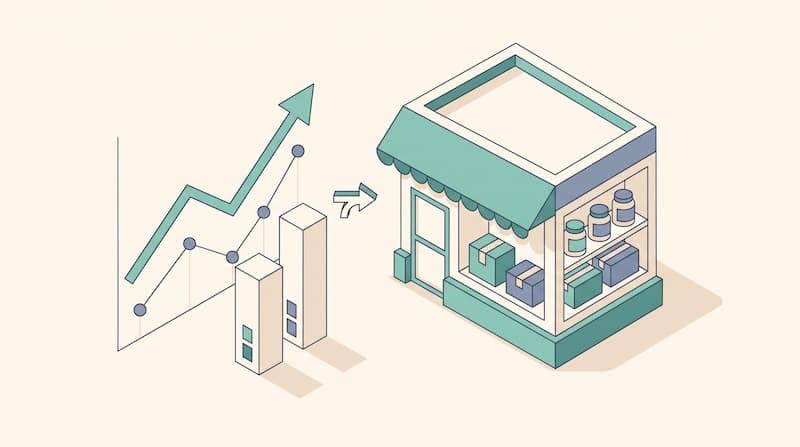
AI Demand Forecasting for Independent Retailers: Less Dead Stock, Fewer Stockouts
Cash tied up in stock that won't sell, and empty shelves where the money is — most independent shops live with both at once. Here's how AI forecasting fixes the ordering guesswork behind it.
Every independent retailer knows this squeeze. Half your cash is tied up in stock that's been sitting on the shelf for months and will probably end up marked down to nothing. Meanwhile the stuff people actually want keeps selling out, and every empty shelf is a sale that walked out the door — often to Amazon. You're overstocked and understocked at the same time, on different products.
Both problems have the same root: ordering is a guess. You order from gut feel, last year's memory, and whatever the rep is pushing this month. Sometimes the guess is right. Often it isn't, and you pay for it twice — in dead stock and in lost sales.
Why guessing is so hard to beat by hand
Demand isn't random, but it is complicated. It shifts with the season, the weather, paydays, local events, promotions, and trends that move faster than your ordering cycle. No owner, however experienced, can hold all of that in their head across hundreds or thousands of SKUs. So you fall back on rules of thumb — "order the same as last time" — which is exactly how you end up overstocked on the slow movers and out of the fast ones.
What AI demand forecasting actually does
It does the thing you can't do by hand: it looks at your real sales history, product by product, and works out what each one is likely to sell in the coming weeks — accounting for the season, the trend, and the patterns you'd never spot across your whole range at once.
In plain terms, it turns "I think we need more of these" into "based on how these have actually sold and what's coming, order this many, now." It flags the slow movers eating your cash so you can stop reordering them, and warns you before your winners run dry so you don't hand the sale to a competitor. Better forecasts mean you can hold less stock overall and still have the right things on the shelf — which frees up cash and cuts markdowns at the same time.
What this typically looks like
An illustrative picture, not a specific store. An independent shop carries a wide range and runs on gut-feel ordering. A chunk of the shelf is slow-moving stock that eventually gets discounted, while the best-sellers regularly sell out mid-week.
After putting a forecasting tool on their sales data, ordering shifts from memory to what the numbers actually say. Reorders on the dead stock stop, so that cash comes back. The fast movers get topped up before they run out, so fewer sales are lost. The shop carries less total inventory but has the right products in stock more often — less money frozen on the shelves, fewer markdowns, fewer empty spots where the profit was. The owner spends less time agonizing over orders, too.
Why this matters more for independents
Big chains have had demand forecasting for years — it's a large part of why their shelves are rarely empty and their markdowns are lower than yours. As an independent, that used to be out of reach. It isn't anymore. Modern tools plug into the point-of-sale system you already have and do this without a data team or an enterprise budget. This is one of the clearest places a small retailer can close the gap with the big players.
A low-risk way to start
You don't have to overhaul your buying overnight. Start with one category — ideally your highest-value or most troublesome one — and let the forecast guide ordering there for a couple of cycles. Compare it against how you'd have ordered by gut. Once you trust it on one category, roll it across the range.
If you want a read on how much cash is currently frozen in slow stock and what better forecasting could free up, our free AI-readiness audit walks through it in a few minutes — or book a call and we'll look at your range together.