AI for Logistics SMBs: Clearing Warehouse Bottlenecks and Lifting On-Time Rate
One slow step in your warehouse quietly drags down your whole on-time rate — and you usually can't see which one. Here's how AI finds the bottleneck and helps you clear it without a warehouse rebuild.
If you run a small or mid-sized logistics operation, you live and die by one number: on-time. Miss it and customers churn, penalties stack up, and your team spends the day firefighting instead of shipping. And the maddening thing is that when the on-time rate slips, it's often not obvious why. Everyone's busy, everyone's working hard, and orders are still going out late.
That's almost always a bottleneck problem. Somewhere in your flow — receiving, putaway, picking, packing, dispatch — one step is quietly holding up everything behind it. Fix that one step and the whole line speeds up. The hard part is finding it.
Why you can't see the bottleneck
In a warehouse, the slow step hides. Work piles up in front of it, so the people at that station look flat out — they are flat out — while stations downstream sit waiting. Owners often throw more hands at the busy-looking area, which does nothing, because the constraint is somewhere else entirely. Without clear data on how long each step actually takes and where orders sit, you're guessing.
What AI actually does here
Two jobs, both plain:
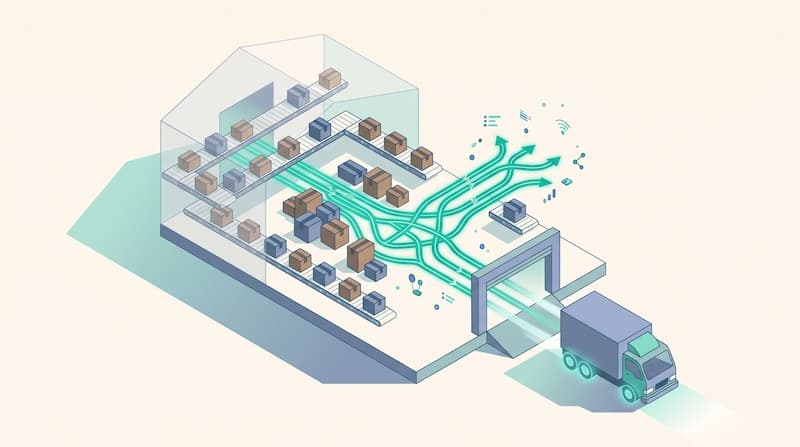
- It finds the bottleneck. By watching how orders move through your steps, it shows you where they pile up and how long they wait. Instead of "picking feels slow," you get "orders sit an average of forty minutes waiting for putaway before they can be picked." Now you know exactly where to push.
- It sees trouble coming. Rather than reacting to a late order after it's late, it flags risk early — this batch is running behind, that inbound shipment will land during your busiest window, this order won't make the cutoff at current pace. That gives your team time to reshuffle before the promise is broken instead of apologizing after.
Some setups add smarter picking routes and demand-aware labor planning on top, so staff are lined up against the volume that's actually coming rather than a fixed roster. But the foundation is visibility: you can't fix a bottleneck you can't see.
What this typically looks like
An illustrative picture, not a specific company. A regional distributor running in the low-to-mid nineties on on-time delivery can't work out why they keep missing. Everyone's busy; orders still slip.
The data shows the real culprit: orders bunch up waiting for one putaway step, which starves picking downstream, which pushes packing past the dispatch cutoff. Once that's visible, the fix is unglamorous — reslot the fast-movers, add capacity at that one step at the right time of day — and the on-time rate climbs a few points. A few points sounds small until you count the retained customers and the penalties you stopped paying. No new warehouse, no rip-and-replace. Just seeing the constraint and acting on it.
Why this fits SMB logistics specifically
Big carriers have whole teams and expensive systems watching this. Smaller operations usually don't — which is exactly why the bottleneck stays hidden and the on-time rate stays stuck. Modern AI tools put that same visibility within reach without an enterprise budget or a six-month rollout. You're not competing on fleet size; you're competing on reliability, and reliability is a visibility problem you can now afford to solve.
Where to start
Start by measuring, not automating. Get clear data on how long each step takes and where orders wait for a few weeks. The bottleneck usually reveals itself fast, and often the first fix costs nothing but a change in how you sequence work. Automate once you know where the constraint really is.
If you want help pinpointing where your flow is losing time — and what lifting your on-time rate would be worth — our free AI-readiness audit gives you a straight read, or book a call to dig into it together.