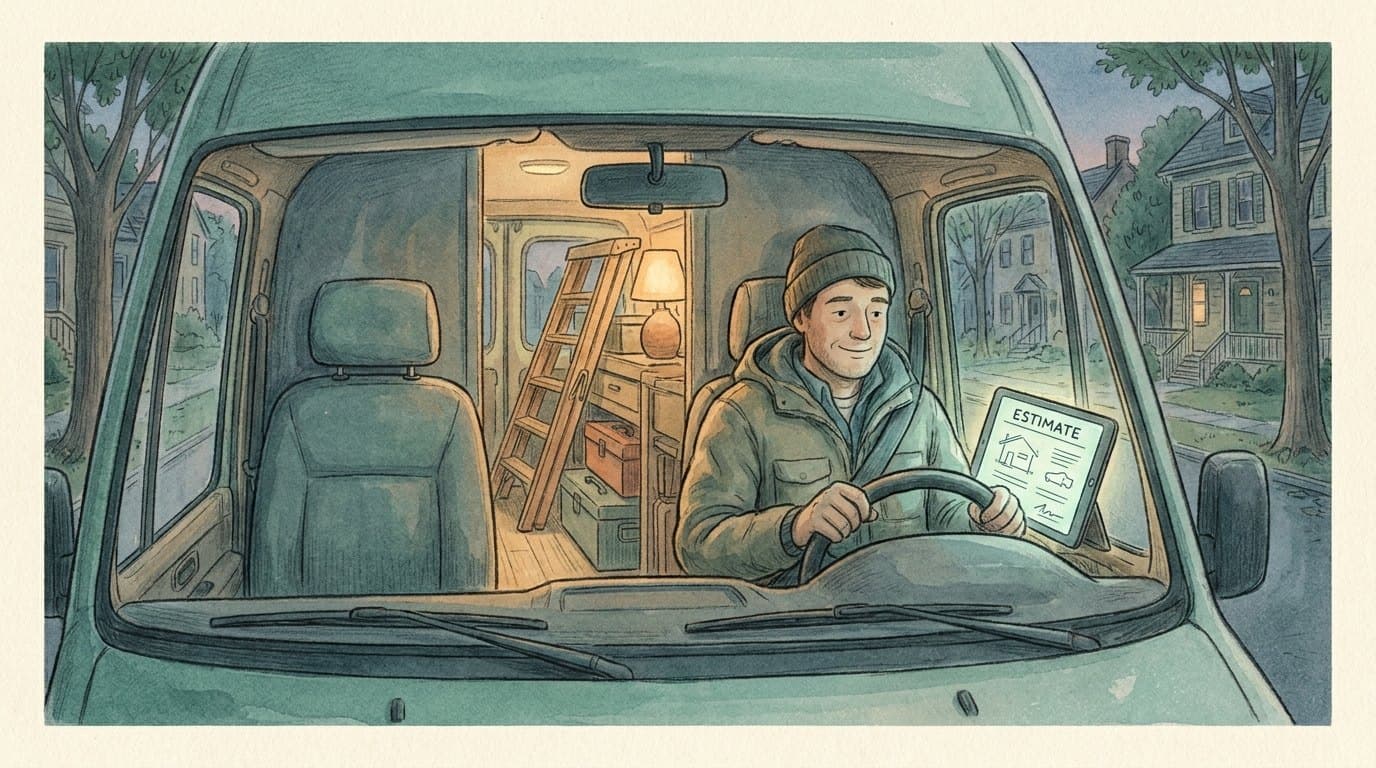
Your Quotes Take Three Days. That's Why You're Losing Work.
In most trades and B2B services the fastest quote wins, not the cheapest. Here's why quoting always slips to the end of the day, what it's costing you in jobs you never hear about, and how to turn three days into three hours.
A customer rings on Tuesday morning. You go and look at the job Tuesday afternoon. You mean to write the quote that evening, but there's a problem on another site, so it slips. Wednesday is busy. Thursday evening you finally sit down, dig out the measurements, check the current material prices, and send it.
By Thursday evening they've had two other quotes. One arrived Tuesday night.
You might still win it. But you're now the one being compared, rather than the one setting the standard, and if the numbers are similar the person who replied first usually gets the benefit of the doubt. That's not a pricing problem. It's a queueing problem.
Why quoting always slips
It's not laziness and it's not disorganisation. Quoting has a structural disadvantage: it's the only important task in the business with no deadline attached.
It's unpaid work. Every hour spent quoting is an hour not spent on a job that's already been won. When the day gets tight, the paid work wins — every time, in every business.
It requires you specifically. Anyone can answer the phone. Only the person with the experience can look at a job and know it's a day and a half, not a day. That bottleneck is one person wide, and that person is also on the tools.
It's fiddly. Measurements, current prices, labour, access, materials, a margin that reflects how awkward the client seemed. Twenty minutes of assembling if everything's to hand, an hour if it isn't.
Nobody chases you. A late invoice gets chased. A late delivery gets chased. A quote that never went out is invisible — the customer just goes elsewhere without telling you. That's what makes this leak so hard to see: the evidence of it is entirely absent.
What it's actually costing
Have a rough go at this, because the number is usually larger than expected.
Count the enquiries you got last month. Count the quotes you actually sent. The gap is quotes that never happened — most businesses find it's somewhere between a fifth and a third, and they're always surprised.
Then take the quotes you did send and ask how many went out within 24 hours. Across the trades and B2B services we work with, response time correlates with win rate more strongly than price does, within a sensible range. Not because customers are impatient, but because a fast, complete quote is read as evidence that you're organised and will turn up when you say you will. It's a competence signal.
If you send eight quotes a month at an average of £3,000, and slow turnaround costs you one of them, that's £36,000 a year. Against work you'd already done the hard part of — you went and looked at it.
Where a tireless teammate fits
The instinct is that you can't automate quoting, because pricing a job takes judgment. That's true and it's also the wrong boundary. The judgment is about ten percent of the elapsed time. The rest is assembly, and assembly is exactly what an AI employee is for.
Here's the split that works:
- It captures the enquiry properly, immediately. When someone rings or messages, the details get taken and logged — the property, the job, access, timing, how they found you — while they're still on the line, at any hour. No more "I've got it written on the back of a delivery note somewhere."
- It drafts the quote from your own history. Pull the last three similar jobs you priced, the current material costs, your standard labour rates and terms, and assemble a draft in your format. Not a guess — a starting point built from how you have actually priced work like this before.
- You do the judgment bit. You open the draft, adjust for the things only you can see — the awkward access, the customer who'll want changes, the fact that it's a good client — and send. Ten minutes, not an hour.
- It follows up so you don't have to. A polite nudge at day three, another at day ten. This alone converts work that was already sitting there. Almost nobody does it consistently, because it's a task with no deadline attached, which is where we came in.
- It tells you what's outstanding. One list of every quote sent, what stage it's at, what's gone quiet. Not a system to maintain — a picture that stays current on its own.
What it doesn't do is set your prices or send anything without you seeing it. That's the boundary, and it's the reason the whole thing is trustworthy.
What changes
The obvious change is speed: three days becomes the same evening, sometimes the same hour. But two less obvious things matter more.
You quote everything. The enquiries that used to fall off the end of a busy week now get a draft sitting ready. The gap between enquiries received and quotes sent closes, and that gap was pure lost revenue.
Your evenings come back. Quoting is the classic after-hours task — the thing you do at nine at night because it's the first quiet moment. Turning an hour of assembly into ten minutes of judgment is the difference between a working evening and an evening.
And there's a compounding effect. Every quote you send teaches the system a little more about how you price, so the drafts get closer to what you'd have written. After a few months, most need almost nothing.
Where to start
Don't try to automate the whole thing at once. Start with capture: get every enquiry logged completely, at the moment it arrives, no matter the hour. That alone stops the leak, and it takes days rather than weeks to put in.
Add drafting once you can see a month of clean, complete enquiries — because that's the material the drafts get built from. Add follow-up last; it's the easiest piece and it works better once the first two are steady.
If you want a read on where your own quoting is leaking, our free AI-readiness audit takes a few minutes and gives you a plain answer. Our industries page covers how this looks for trades, and pricing sets out what it costs to put in.
At BuildPulse, we'd rather your quotes went out on Tuesday night than Thursday.