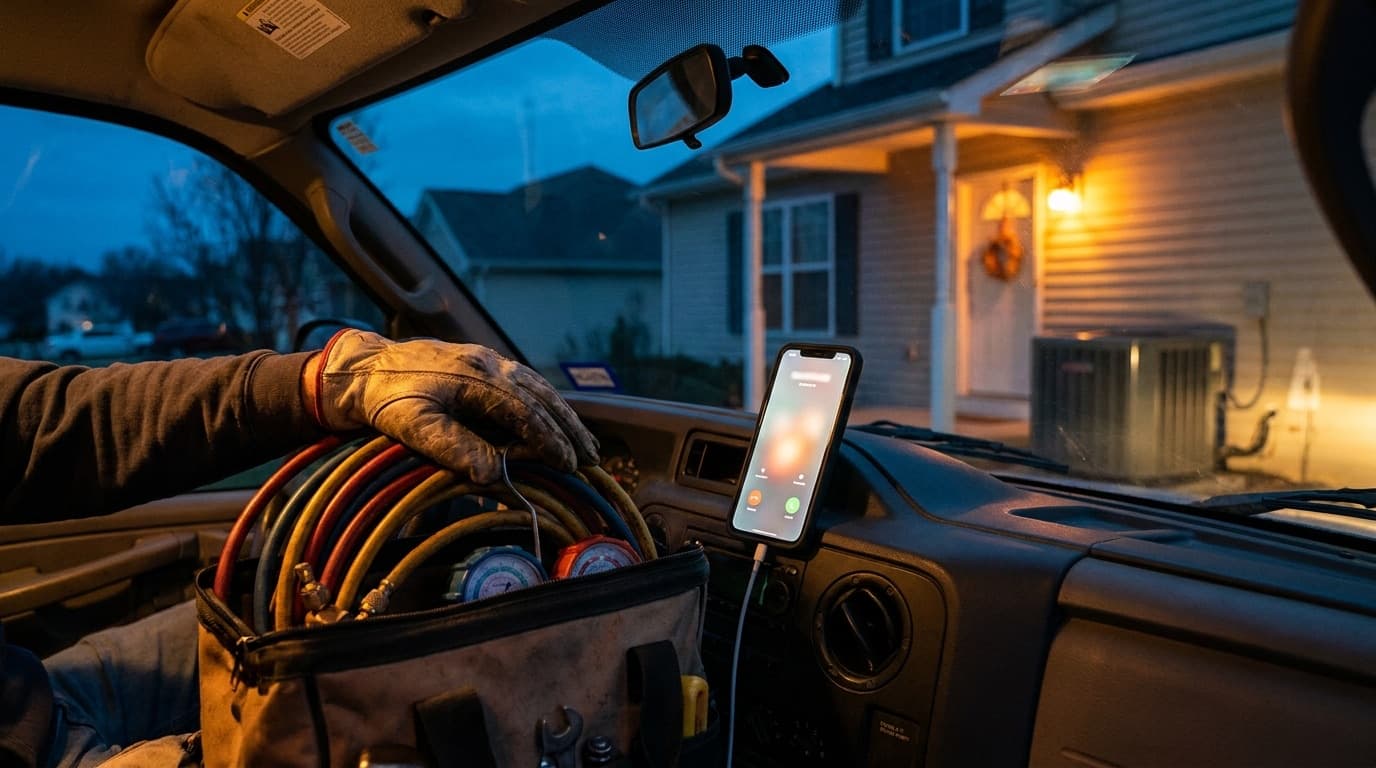
AI for an HVAC Business: Which Jobs to Hand Over and Which to Keep
AI can answer the calls your techs miss, chase open quotes and fill the spring and fall tune-up calendar. It should not diagnose a furnace or set your prices. Here's where the line sits.
AI is useful in an HVAC business today for the office work around the job. It can answer the calls nobody is free to take, follow up on quotes that went quiet, book and remind customers about seasonal tune-ups, and ask happy customers for a review. It should stay out of diagnosis, safety calls and pricing. Start with the phone line after hours, because that's where lost jobs are easiest to count.
The rest of this article goes task by task. For each one you'll find what the AI does, where it stops, and what you need to have ready before you switch it on.
Why HVAC is a good fit for this kind of help
Your demand comes in waves you don't control. The first cold night of the year, everyone's furnace gets tested at once. The first heat wave does the same to air conditioners. The Bureau of Labor Statistics notes that HVAC technicians may be on call for emergencies and sometimes work overtime or irregular schedules during peak heating and cooling seasons.
Those are the weeks when the phone rings most and the fewest people are free to answer it. Your techs are in attics and crawl spaces. The person in the office, if you have one, is on another line. You can't hire for a three-week spike, and you can't afford to send the spike to voicemail either.
AI is good at exactly this shape of problem: lots of short, similar conversations that need an answer right away and a person only some of the time.
After-hours and mid-job calls
This is the first job I'd hand over, and in the first month it should be the only one.
A homeowner whose AC quit at 8pm in July calls the first company they find. If nobody picks up, they call the second. An AI responder on your business number picks up on the first ring, any hour, and says it's an automated assistant for your company. Then it does four things:
- Asks what's wrong, the address and how urgent it is.
- Answers the standard questions you gave it, like your service area, whether you work on heat pumps or boilers, and your diagnostic fee if you want that quoted.
- Books a slot in your calendar or takes the details for a callback.
- Sends you a short summary by text or email.
You decide what counts as an emergency. A no-heat call from a home with a newborn, water coming through a ceiling from a condensate line, or a commercial walk-in cooler that's warming up can ring your on-call phone straight away. Everything else gets a booked slot or a callback first thing.
If you want this set up for you, that's what our AI lead responder for calls, texts and web forms does. If you're still deciding between an AI, a live answering service and a simple text-back, our side-by-side of the three after-hours options lays out the trade-offs.
Quote follow-up on replacements and installs
Repair calls get decided on the spot. Replacements don't. A homeowner looking at a new system may want other quotes and a week to think. If nobody in your office has time to chase the quote, it just sits there.
AI can do the chasing. An example of how it works, with made-up numbers: you quote a $12,000 heat pump replacement on Monday. On Wednesday the customer gets a short message asking whether they have questions about the options. On the following Monday they get another one, maybe pointing out that your install calendar for next month is filling up, if that's true. If they reply with a question the AI can't answer, like "can you match this other quote?", it goes to you.
What the AI should not do here is negotiate. It can remind, answer questions about what's in the quote and book the install once the customer says yes. Discounts, financing terms and price matches stay with whoever owns the numbers.
The hard part is usually getting the quote data out of wherever it lives today. We cover that in our guide to turning a site visit into a sent quote faster, and our AI quote automation service builds it for you.
Booking, reminders and the maintenance plan
ENERGY STAR advises homeowners to have a contractor do annual pre-season check-ups, with the cooling system checked in the spring and the heating system in the fall. That gives you two predictable booking windows a year. If you work them by hand from a spreadsheet or your field-service software's customer list, this is the part to hand over.
An AI assistant can take that list and send each maintenance-plan customer a reminder with a few open slots. When the customer picks one, it books it. When they ask to reschedule, it moves the job. A day before the visit it confirms the time and tells them what to expect, for example that a tech needs access to the furnace and the outdoor unit.
One legal point before you switch on any outbound calling. In February 2024 the FCC confirmed that AI-generated voices count as "artificial" under the Telephone Consumer Protection Act, which means an AI voice calling a customer needs that customer's prior express consent. Texts and calls to people who signed up for your maintenance plan are a different situation from cold calls to a purchased list. Check your consent wording with whoever handles your legal paperwork, and keep the AI to answering inbound calls until you have.
Review requests
After a job closes, a short text asking how it went and linking to your review page is easy to automate. The AI sends it a few hours after the tech marks the job complete, and if the customer replies with a complaint, it goes to you instead of getting a canned answer.
One rule applies here. The FTC's 2024 rule on reviews bans businesses from offering incentives conditioned on a review expressing a particular sentiment, so no "five stars gets you $25 off." Ask every customer the same way. And when someone replies unhappy, have the AI pass it to a person so you can fix it, rather than quietly dropping it.
Where a human has to stay
This list matters more than the one above. An AI that does too much in an HVAC business can hurt someone.
Diagnosis. The AI can collect symptoms, like "blowing warm air," "short cycling" or "ice on the outdoor coil," and pass them on so your tech arrives with the right parts. It should never tell a customer what's wrong or suggest a fix they can try themselves beyond what you've written for it, such as checking the thermostat batteries or the breaker.
Safety. If a caller mentions a gas smell or a carbon monoxide alarm, the AI's only job is to tell them to leave the house and call for help, then alert you. The Consumer Product Safety Commission's advice for suspected CO poisoning is to get outside to fresh air immediately and then call 911. Write that script word for word and test it before the system goes live.
Refrigerant and regulated work. The EPA requires that technicians who maintain, service, repair or dispose of equipment that could release ozone-depleting refrigerants must be certified. An AI has no business giving advice on topping up refrigerant or anything near it.
Pricing judgment. Your diagnostic fee and standard tune-up price can sit in the AI's script if you want customers to hear them. Repair estimates, replacement quotes, discounts and "can you do it cheaper" belong to a person who can see the job.
Upset customers. A callback complaint, a warranty dispute or someone angry about a bill goes straight to a human. The AI's job is to take the details and say when someone will call.
We wrote a longer piece on tasks you should keep away from an AI employee that applies to most service businesses, not only HVAC.
How to start
Pick one task. For most HVAC shops I'd pick the after-hours phone, because you can measure it. Your phone system already logs missed calls, so after a month you can count how many the AI answered and how many turned into bookings.
Then, in order:
- Write down your rules. Which calls are emergencies, who's on call, which areas you cover, what you'll quote on the phone and what you won't.
- Write the safety script. Gas smell and CO alarm wording, checked by you, word for word.
- Connect it to the calendar you use now. No new software for your techs.
- Run it after hours only. Read every call summary for the first two weeks. Fix the answers that were wrong.
- Add the next task. Usually quote follow-up, then the spring and fall reminders.
If someone builds it for you, ask for a go-live date in writing. For a single task like this, ours is a planned go-live in 2 to 3 weeks. If you'd like help deciding which task comes first in your shop, our notes on picking a first AI project walk through the reasoning, and the home services and trades page shows how we work with firms like yours.
If your shop does plumbing as well, our guide to AI for a plumbing business covers burst-pipe calls at night, the rules for sorting real emergencies from next-day jobs, and water heater reminders. If you have electricians on staff, the guide to AI for electrical contractors covers EV charger and panel upgrade intake, permit tracking and change orders on bid work.
Frequently asked questions
Can AI answer the phone for an HVAC company?
Yes. An AI voice assistant can pick up calls on your existing number, ask what's wrong, book a slot in your calendar and send you a summary. You can forward calls to it only after hours, or only when nobody answers within a few rings, so the calls you pick up still reach you. It should say it's an automated assistant and hand emergencies to your on-call tech.
Will AI replace HVAC technicians?
No. AI can't install a system, read a pressure gauge or crawl into an attic. What it takes over is office work, such as answering calls, chasing quotes, sending reminders and asking for reviews. That leaves your techs and your office manager with fewer interruptions, and it doesn't change who does the work on site.
What should an HVAC company automate first?
Missed and after-hours calls. They pile up in the weeks when your crew is busiest, and you can count them in your phone logs. After a month you'll know how many the AI booked. Quote follow-up and maintenance reminders are good second steps.
Can AI diagnose HVAC problems over the phone?
It shouldn't. An AI can ask about symptoms and pass them to the tech so they bring the right parts, but deciding what's wrong needs someone who can see and test the equipment. For gas smells or a carbon monoxide alarm, the AI should tell the caller to get outside and call 911, then alert you.
Not sure which of these would pay off in your shop? Our free AI-readiness audit takes a few minutes, or book a call and we'll go through your call logs and quote process with you.