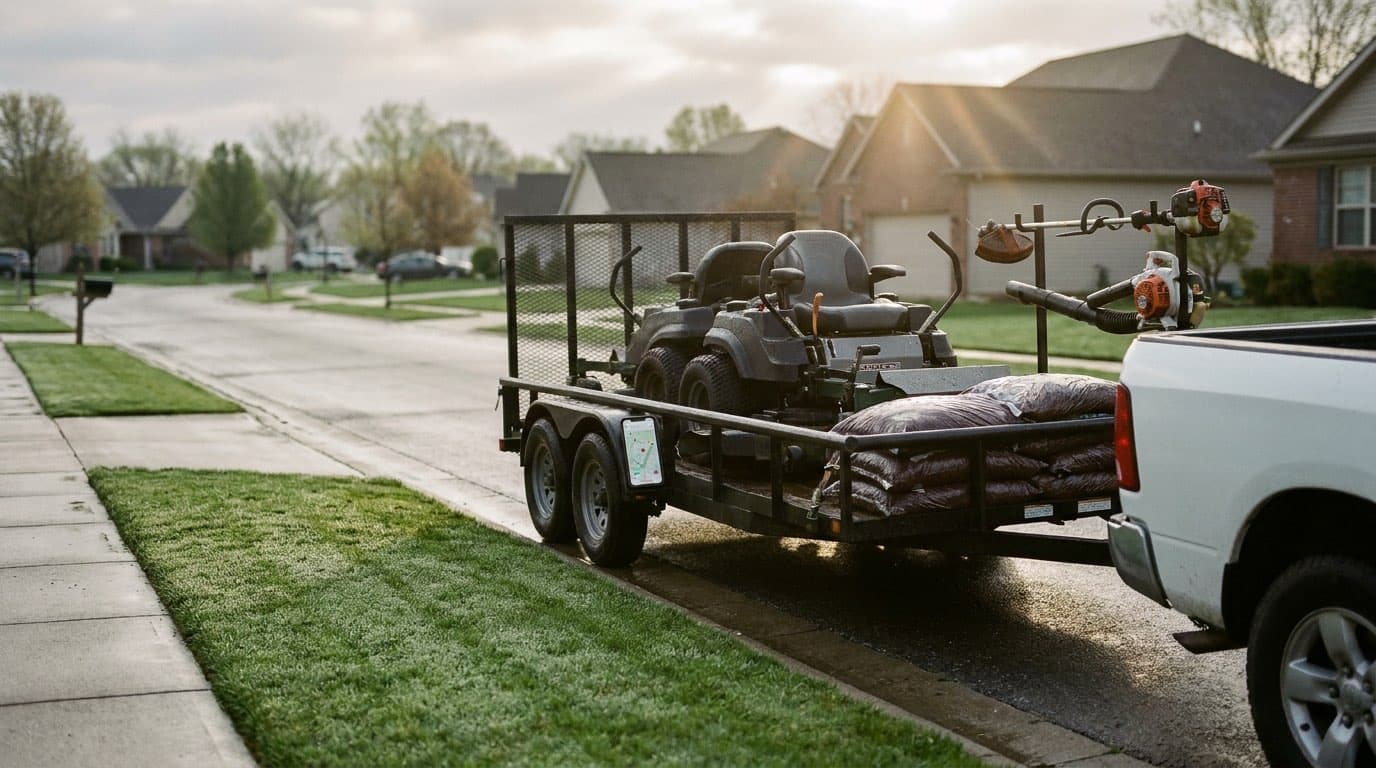
AI for a Landscaping Business: What to Hand Over Before Spring
Landscaping and lawn care companies get most of their calls in the months when everyone is out on a mower. An AI assistant can answer those leads, draft estimates from property measurements, send renewals for next season, reshuffle routes on rain days and chase unpaid invoices. Prices, treatments and complaints stay with you.
AI for a landscaping business is most useful in the months when nobody has time to sit at a desk. From April to October the owner of a small lawn care or landscaping company mows, estimates, orders mulch and answers the phone from the seat of a mower. An AI assistant can take over the parts of that job that follow rules. It can answer new leads, draft an estimate from lot measurements and photos, send renewals to last year's customers, rebuild the week's routes after a rain day and remind customers about unpaid invoices.
You keep the decisions that need judgment or a license. You set prices, you decide what goes on a lawn and when, and you deal with the customer whose sprinkler head got clipped.
Why landscaping office work comes in waves
Lawn care follows the weather. The Bureau of Labor Statistics notes in its Occupational Outlook Handbook entry for grounds maintenance workers that some of these jobs are seasonal. Crews are busiest in spring, summer and fall, when planting, mowing and trimming peak, and some take on snow removal in winter. The same entry counts about 1.3 million grounds maintenance jobs in 2025, and one in five workers is self-employed.
So the office work arrives in waves too. Estimate requests pile up in March and April, right as you're hiring crews and getting equipment ready. Midsummer brings irrigation calls and customers asking to skip a week. Fall brings cleanup jobs and the question of who renews for next year. Winter is quiet unless it snows, and then the phone rings at 5 a.m.
A small company handles every one of those waves with the same two or three people who are also doing the work.
New leads while the crew is mowing
A homeowner calls at 2 p.m. on a Tuesday in April. You're on a mower with ear protection on. By the time you check your phone at 6, they've booked whoever picked up.
An AI assistant can answer that call, text or web form right away and ask what you'd ask:
- The address, so it can check whether the property sits inside your service area
- What they want: weekly mowing, a spring cleanup, mulch and bed work, a new planting, a patio, snow plowing
- How often, for recurring work
- Whether there's a gate, a dog or an irrigation system the crew needs to know about
- How they'd like to get the estimate, and whether they want to be home for a visit
Then it sends you a summary and tells the customer when to expect a price. If the request is something you don't do, like tree removal or pesticide treatments you aren't licensed for, it says so politely and the customer can look elsewhere the same day. Our AI lead responder is the piece that answers those calls and messages. If after-hours calls are your main leak across trades, our post on catching after-hours leads goes into more detail.
Estimates from lot measurements and site photos
Most mowing prices already follow a formula, even if it only exists in the owner's head. Turf area, how many visits a season, a surcharge for steep slopes or lots of trimming around beds, and a minimum per visit. Write those rules down and an AI can apply them.
The measurement is the part that used to need a drive-by. If you already measure turf area on a satellite map, with a measuring tool in your scheduling software or the county's parcel viewer, an AI assistant can take the address, pull that measurement into the draft, add the customer's photos of the back yard, and lay out a price by your rules. You look at the map and the photos, adjust for anything the satellite can't see, and approve.
The draft should flag what it can't price. Overhanging trees hide turf on an aerial image. A photo doesn't show a soft, wet low spot or how far the crew has to carry clippings. Any job that falls outside your rules goes to a site visit instead of a price, and the assistant can offer the customer a time.
Design and build work is different. A patio, a retaining wall or a full planting plan needs you on the property, and the price depends on what's under the soil. There the assistant can turn your site notes or a voice memo into a written estimate with materials listed, so you're not typing it up at 10 p.m. You still check the quantities and set the number.
Our AI quote automation builds drafts like this from your own price list. If your prices aren't written down anywhere yet, our guide to getting quotes out the same day starts there.
Renewing maintenance contracts for next season
A lawn care company with recurring customers starts each year with a list of people who might come back. Somebody has to ask them, ideally before your competitors do.
An assistant can send each of last season's customers a renewal message in late winter, with the same services, the new season's price and a link or a reply to confirm. It can answer "can we add aeration this year?" or "we're moving in June" and update the record. Customers who don't answer get one reminder, then go on a list for you to call.
You decide the new prices before anything goes out. A price increase is a conversation you have with your own customers, and the assistant only sends the number you approved. If you sell annual treatment programs that renew automatically, check your contract terms and your state's rules on automatic renewals with your attorney before automating the renewal step.
Rain days and crew routes
Here's a made-up week. It rains on a Wednesday, and now Wednesday's 30 lawns need to fit into Thursday and Friday, which already have their own 30 each, and every crew has a different truck and trailer.
An AI assistant can draft the new week. It looks at which crews have room, which properties sit close together, and which customers have a fixed day because of a gate code or a dog that's only inside on Fridays. It also knows which jobs can wait. In its draft, a weekly mow might slide one day, a bed cleanup might move to next week, and a property whose owner wants the lawn done before a weekend party keeps its slot. Your crew leader reads the plan and changes what doesn't fit. Once it's approved, the assistant texts every affected customer the new day.
Fertilizer and weed control add a second check. Iowa State University Extension's advice to homeowners is not to fertilize if moderate to heavy rains are likely within 24 hours, because the rain can wash the fertilizer away before the lawn uses it. An assistant can watch the forecast and flag application stops on days when heavy rain is coming. The applicator decides whether the application goes ahead, following the product label and their own read of the weather.
Invoices and payment reminders
Lawn care invoicing is many small amounts, often per visit or monthly, on top of one-off cleanup and install jobs. Small amounts are easy to forget, on both sides.
An assistant can send the invoice after each visit or at the end of the month, depending on the customer's plan, and send a reminder when one is overdue. It answers "what was this charge for?" by looking up the visit date and the work logged. It can also pause a customer's recurring service when they ask, and note it so the crew skips the stop.
A customer who disputes a charge or says the work wasn't done goes to you. The assistant logs the message and tells the customer when you'll call. It doesn't issue credits on its own unless your written policy says so.
Where a person stays in charge
Some decisions need a person, and for pesticides the law says which person.
Pesticides are the clearest case. BLS notes that most states require licensing for workers who apply pesticides. For restricted use pesticides there's a federal rule on top. The EPA says that federal law requires any person who applies or supervises the use of restricted use pesticides to be certified, and states, tribes and territories run those certification programs. So an assistant can book a treatment visit and send the customer the instructions you wrote, such as how long to keep pets off the grass. It shouldn't recommend a product, a rate or a timing, and any question about safety or a reaction goes to your licensed applicator.
Damage claims stay with a person too. A scratched car, a cut irrigation line or a dead shrub after a treatment needs someone who can look at it and decide what you owe. The assistant collects the photos and the details, and you make the call.
Reviews come last. After a job, the assistant can send a review request to every customer on the same schedule. The FTC's guidance on its consumer reviews rule says that asking only customers you think are happy is not specifically prohibited by the rule, but this practice could violate the FTC Act. The same guidance allows incentives for reviews only when there's no requirement that the review be positive. So send one message to everyone and don't tie a reward to the rating.
How to start, depending on the month
Late fall and winter are the right time to set this up, because the season hasn't started yet and you have time to read what the assistant writes.
If last spring's leads went unanswered, start with intake. Write your questions and your service area down now and run the assistant on the first inquiries of the year. Read every conversation for the first few weeks.
If estimates are the bottleneck, start with your price rules. Take twenty of last year's mowing estimates, have the AI draft each one from the address and the original request, and compare the drafts with what you sent. Wherever they differ, fix the rule before spring.
If renewals slip every year, start there. Clean up last season's customer list first, with addresses, services and what each customer paid, because the assistant can only be as accurate as that list.
Rain-day routing comes after those. It depends on every property, crew and customer preference already sitting in your scheduling software.
Other trades break in other places. Our guide to AI for a cleaning business covers recurring visits and the morning a cleaner calls in sick, and the one on AI for roofing contractors starts with storm-week calls. For seasonal tune-ups, see AI for an HVAC business. Pest control companies get AI for a pest control business, which covers termite inspection drafts and quarterly service plans. Our home services and trades page shows how we set this up for small service businesses.
Frequently asked questions
How can I use AI in my landscaping business?
Start with the office work that piles up while you're in the field. An AI assistant can answer new leads, draft mowing estimates from lot measurements and photos, send renewals to last season's customers, rebuild routes after a rain day and send invoice reminders. You keep prices, treatments and complaints.
Can AI measure a lawn and give a quote?
It can pull a turf measurement from a satellite map or your software's measuring tool and apply your price rules to it. Trees, slopes and hidden obstacles don't show up well on an aerial image, so you check the draft before the customer sees a price. Install and hardscape work still needs a site visit.
What is the best AI tool for landscapers?
There isn't one tool for every job. Pick the job first, such as intake, estimates, renewals or routing, then check what your scheduling and invoicing software already does before buying anything new. If you need it connected to your own price list and calendar, that's a build.
Can an AI assistant answer questions about lawn treatments?
Only with answers you wrote, like how long to keep pets off the lawn after a visit. Most states license pesticide applicators, so product choices, rates and any safety questions go to your licensed staff.
Will AI replace landscapers?
Mowing, planting and building a patio still take a crew on site. What changes is the office side. An assistant can answer leads and handle scheduling and paperwork, but a person still prices the work and stands behind it.
If you'd like a second opinion on where to start, book a call and bring last spring's estimate requests. The AI-readiness audit is the do-it-yourself version.